
A Proposal for a Structured Process on How to Use City Reserves
Table of Contents
Executive Summary
Introduction
Background on the Unencumbered General Fund Balance
Why This Matters Now
Why a Structured Process?
My Proposal: Three Steps
Decision Support Criteria Matrix
Proposed Timeline
Opportunities for Citizen Feedback – Placeholder
Closing
Executive Summary
Dunwoody’s unencumbered general fund balance will be nearly $30 million at the start of 2026, equal to about 10 months of operating funds — far above the city’s minimum policy (4 months) and the national standard (2 months).
On September 29, City Council will begin a conversation on how to allocate the city’s unencumbered general fund balance. This process could be completed as early as the second council meeting in October: 10/27.
These are one-time dollars already paid by citizens, set aside through years of conservative budgeting. Unlike grants or SPLOST funds, they are flexible and can be invested where Council chooses.
Council must decide how much to retain in reserve (4, 5, or 6 months, or somewhere in between) and how much to invest back into the community.
To ensure fairness and transparency, I am proposing a structured three-step process:
Define the Size of the Pie — Decide how much to keep in reserve vs. invest.
Divide the Pie — Allocate percentages across categories: Parks, Public Works, and Public Safety.
Decide What to Spend It On — Use a Decision Support Criteria Matrix to evaluate projects consistently.
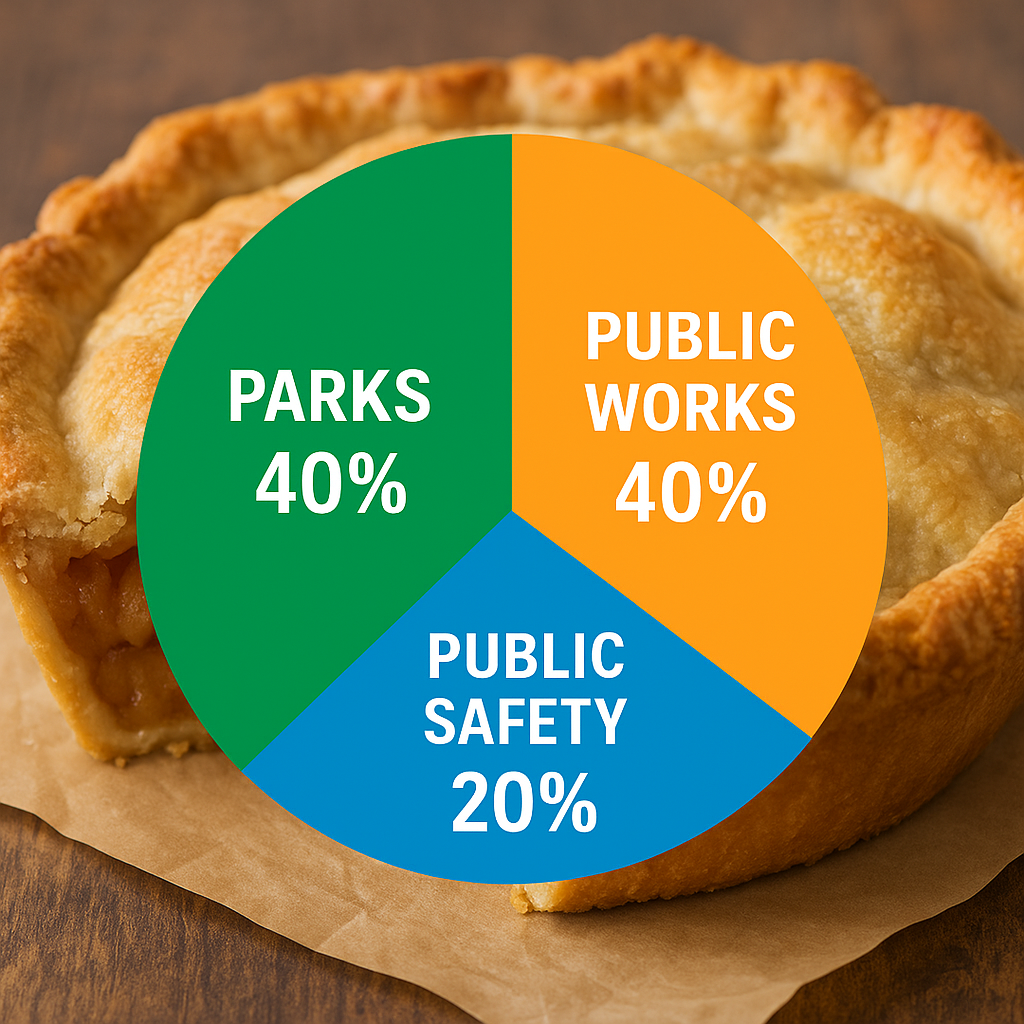
My personal starting suggestion: 40% Parks, 40% Public Works, 20% Public Safety.
My proposed timeline would run from September 29 through December 1, with Council review, staff-prepared project lists, and a public open house with online feedback before final approval.
Importantly: This proposal is not about which projects to fund. It is only about the process and criteria we will use to make decisions together.
Introduction
On September 29, City Council will begin a conversation on how to allocate the city’s unencumbered general fund balance. These are one-time dollars — funds that citizens have already paid through their taxes — and any decisions about them must be thoughtful, transparent, and fair.
Some may suggest moving quickly and finishing this decision by the end of October, bundled together with the approval of the 2026 budget. While that option would certainly be faster, I believe it risks rushing decisions that deserve a more deliberate process with citizen input and careful consideration.
I want to be clear: this is simply a suggestion to start the conversation, not a conclusion. Whatever we decide will come from discussion and consensus among the full Council. For me, it is far more important that we do this right than that we do it fast. I could be flexible in condensing the timeframe if that is the will of Council, but I believe the integrity of the process and its steps must remain intact.
👉 This proposal is not about which projects to fund, but about establishing the fair process and evaluation criteria we will use to make those decisions together later.
Background on the Unencumbered General Fund Balance
The dollars we’re discussing are part of the city’s unencumbered general fund balance. Simply put, this is the city’s savings account — money set aside each year when our revenues exceeded our expenses. It is called “unencumbered” because it is not already spoken for or legally committed. Unlike federal grants or SPLOST (Special Purpose Local Option Sales Tax) funds that must be used for specific purposes, this balance is flexible — Council can decide how best to use it.
These are not new tax dollars; citizens have already paid them. Because Dunwoody has budgeted conservatively and lived within its means, this balance has grown year after year, even earning interest.
Why This Matters Now
At the start of 2026, Dunwoody’s unencumbered general fund balance will stand at $29,950,090 — equal to nearly 10 months of operating funds. That is far above both our city’s policy and national guidelines.
Our founders set a minimum policy of four months in reserve. The Government Finance Officers Association (GFOA) recommends just two months. Even during the COVID-19 pandemic, Dunwoody never had to use its reserves.
The question before us now is: How much should we keep in savings, and how much should we invest back into the community?
And here’s why this moment is especially important:
- Generational investments: Capital projects like parks, sidewalks, and safety improvements last for decades and shape quality of life.
- Inflation is rising: Construction, labor, and materials will almost certainly cost more tomorrow than they do today. Acting sooner saves money.
- Balance: Citizens deserve to see their tax dollars reinvested visibly in the community, while still keeping a strong safety net in reserve.
- Supporting our economy: Strong parks, infrastructure, and public safety investments help retain and attract businesses — and their employees and families — who provide nearly 70% of our city’s operating funds.
Why a Structured Process?
As a retired U.S. Army Major, I was trained in the Military Decision-Making Process (MDMP) — a disciplined method for analyzing problems, developing courses of action, and selecting the best solution. Later in my civilian career as a project manager at Accenture, I led large, complex initiatives where we applied similar approaches to bring order, transparency, and fairness to tough decisions.
That experience shapes how I approach this issue. I believe Dunwoody should apply the same discipline here: define the process up front, gather input along the way, and then move forward together with confidence.
My Proposal: Three Steps
Step 1 – Define the Size of the Pie
Council must decide whether to hold four, five, or six months in reserve — or some number in between the current surplus and the four-month minimum — and free up the rest for community investment.
To make this relatable:
- Four months = about enough savings to run the city from January through April.
- Six months = holding half a year of operating funds in savings — at the cost of delaying projects residents could use today.
Here’s what each option would mean:
Option 1: Keep 4 Months in Reserve
Leaves $17,339,185 available for projects.
✅ Pros: Matches the city’s established policy; provides the most money for improvements like parks, road safety, and infrastructure; still keeps twice the national recommended savings; demonstrates confidence in our financial stability; and allows us to act sooner before inflation increases costs further.
⚠️ Cons: Offers less of a cushion compared to holding more months in reserve, though still well above national guidelines.
Option 2: Keep 5 Months in Reserve
Leaves $14,864,460 available for projects.
✅ Pros: A middle-ground choice — keeps more in savings while still freeing up significant dollars for visible community improvements; also limits the impact of inflation by allowing near-term projects to proceed.
⚠️ Cons: About $2.5 million less for projects compared to the 4-month option, meaning fewer upgrades can be funded right away.
Option 3: Keep 6 Months in Reserve
Leaves $11,711,734 available for projects.
✅ Pros: Provides the largest financial cushion — covering half a year of operating funds if something unexpected happens.
⚠️ Cons: Ties up nearly $6 million more than the 4-month option, which reduces what can be invested today in parks, infrastructure, and safety. Inflation could also erode the buying power of these dollars if projects are delayed.
👉 For me personally, I believe keeping four months in reserve — the same policy established by our founders — is the right approach. It provides a strong safety net while also allowing us to invest nearly $17.3 million into one-time projects that directly improve quality of life for our residents. That said, I am one of seven elected officials, and this will be a collective decision of the Council.
Step 2 – Divide the Pie
Once we know how much we can invest, the next step is to decide what categories of projects to fund and what percentage of the total each category should receive. These percentages will be set by Council in this step, ensuring a clear balance across priorities before any individual projects are considered. Staff will then go forward with this direction and use these numbers to prepare and provide an initial draft project list to Council.
I propose three main categories:
1. Parks — Examples: playground upgrades, shade structures, athletic fields, restrooms.
2. Public Works — Examples: roadway improvements, adding sidewalks, fixing intersections, right-of-way improvements, multi-modal connectivity.
3. Public Safety
Roadway safety (pedestrian crossings, traffic calming, accessibility improvements). These investments would also directly support and advance the City’s Road Safety Action Plan (adopted in 2023).
Law enforcement (equipment, vehicles, or other one-time needs).
Note: While the focus is primarily on one-time capital, a small portion of this category may be used for related programming, staff work, or citizen engagement necessary to support and implement these safety improvements.
👉 For me personally, a balanced starting point would be:
- 40% Parks
- 40% Public Works
- 20% Public Safety
Step 3 – Decide What to Spend It On
Only after Steps 1 and 2 are complete should we discuss specific projects. To do that fairly, I am proposing we use an evaluation framework — the Decision Support Criteria Matrix.
Decision Support Criteria Matrix
Before listing the criteria, it’s worth explaining the purpose: this matrix is designed to bring fairness, transparency, and discipline into how projects are evaluated. Instead of debating projects in isolation, each one will be scored against the same set of standards. This ensures decisions are clear to both Council and citizens.
Strategic Alignment — Does it align with Council priorities, Master Plans, the Capital Improvement Plan (CIP), or the Road Safety Action Plan?
Public Safety (Roadway Projects) — Will it measurably improve safety for all roadway users, with Complete Streets & multimodal enhancements (pedestrian crossings, traffic calming, mobility connections, and accessibility needs such as wheelchairs, strollers, visually impaired)?
Urgency & Timing — Is it shovel-ready? Does timing matter for grant matching, construction windows, or cost escalation?
Visibility & Public Trust — Will the project be visible to the community, strengthen trust in city investments, and show results?
Overall Cost & Scale — Smaller projects may provide quick wins and visibility, while larger projects may deliver broader or longer-term impact. Both should be balanced.
Citizen Benefit — How broadly will the project’s benefits be felt across the community?
One-Time Use Guideline — Capital expenditures should be primarily one-time investments. By exception, funds could support operations (e.g., personnel), but only at a very small percentage.
Ongoing Maintenance Needs — What level of recurring annual maintenance will be required to sustain this project? Projects with lower or already-budgeted upkeep may be more sustainable than those that create large new ongoing costs.
Proposed Timeline
Background:
What matters most is that we follow a fair process, not just how fast we move. While it would be possible to complete everything by October 27, my proposal instead lays out a more structured path that ends on December 1. This approach ensures there is time for staff preparation, Council deliberation, and meaningful citizen input along the way.
Sept 29, 2025 — City Council Special Called Meeting (Budget Workshop): Introduce the process; Council directs staff to draft the detailed plan.
Oct 14, 2025 — Regular City Council Meeting: Present full process and timeline. Council makes three key decisions:
Reserve level (Step 1)
Category allocations and set percentages (Step 2)
Adopt the Decision Support Criteria Matrix (Step 3 framework).
Action: Staff directed to prepare a draft project list applying the allocations and criteria for the next meeting.
Oct 27, 2025 — Regular City Council Meeting: Staff presents draft project list for initial Council review and feedback.
TBD (between Oct 27 and Nov 10) — Public Information Drop-In Open House: Present the draft project list to the public in a drop-in format; gather written/online feedback. (Date/time/location TBD. an online feedback mechanism will also be enabled to ensure broader participation.)
Nov 10, 2025 — Regular City Council Meeting: Council reviews and discusses the refined project list (with staff updates). Council evaluates and reviews citizen feedback collected from the drop-in open house and online channels.
Dec 1, 2025 — Regular City Council Meeting: Council vote for final approval of projects to be funded.
Opportunities for Citizen Feedback
The city should agree upon and execute specific opportunities for citizen input — such as surveys, open houses, or online engagement. With the goal of balancing meaningful feedback with an efficient and fair timeline.
Closing
This proposal is about more than spending one-time funds. It’s about showing that decisions are made carefully, fairly, and transparently. By defining the process up front, gathering citizen input, and working toward a final adoption in December 2025, I believe we can make investments that truly reflect our community’s priorities.
👉 Importantly, I am not proposing any specific projects or spending items at this stage. This proposal is only about establishing the process and criteria. The actual project discussions will come later, once Council and citizens have agreed on the framework.
But this is just my proposed framework. I want to hear from you. Do you think this process makes sense? Would it help you feel confident that these decisions are being made fairly? Your feedback will help shape how we move forward together. Send me an email to my city account: joe.seconder@dunwoodyga.gov. If you’d like to let the mayor and all of council know your thoughts, send an email to: councilmembers@dunwoodyga.gov.
On September 29, I will present this proposal for discussion, and I look forward to hearing the perspectives of my fellow Councilmembers and our citizens.