
Building Safer Routes to School on North Peachtree Road
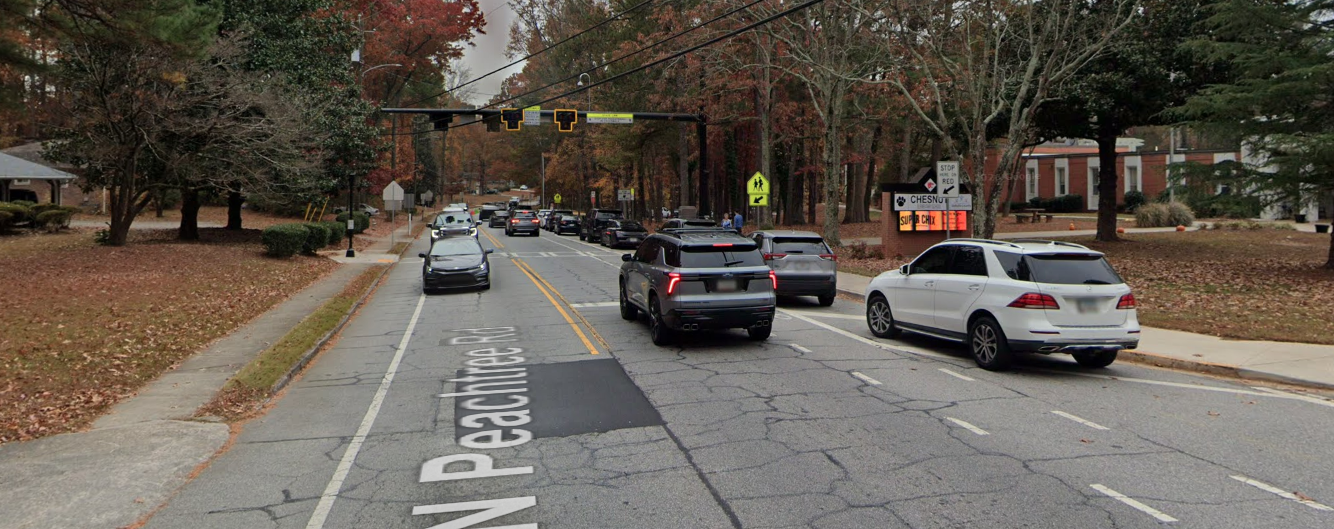
North Peachtree Road during school pickup — a busy corridor where safer sidewalks matter.
TL;DR: City staff are recommending a new Safe Routes to School sidewalk on North Peachtree Road from the Dunwoody Crossing apartments to Chesnut Elementary School. I support that direction and am proposing a modest extension—about 1,000 additional feet—to Kings Point Drive across from Peachtree Middle School. This small change would improve safety for more students and families, end the project at a signalized intersection, and responsibly close the remaining funding gap using future LMIG funds without displacing any projects in the City’s adopted Capital Improvement Program.
Building Safer Routes to School on North Peachtree Road
A Practical Next Step for Kids, Families, and Our Community
Keeping our streets safe for everyone—especially children walking or biking to school—has been one of my highest priorities since the day I first ran for City Council.
In my 2019 campaign kickoff video, I said something I still believe deeply today: we should be building a city where every child can safely walk or ride a bike to school, year-round. That belief continues to guide my work on Council, and it’s why I want to share an update on an important sidewalk project along North Peachtree Road.
This project is another step forward in that journey.
Background: What Staff Is Recommending
City staff are recommending moving forward with a Safe Routes to School sidewalk project on the east side of North Peachtree Road, running from the Dunwoody Crossing apartments to Chesnut Elementary School—approximately 0.4 miles.
This recommendation reflects thoughtful refinement by our Public Works team. An earlier concept explored a much larger and more complex scope, which would have taken longer to deliver. Staff narrowed the project to a more focused segment that can move forward sooner, respond directly to safety concerns raised by residents, and stay within available funding tools.
That work deserves recognition and thanks.
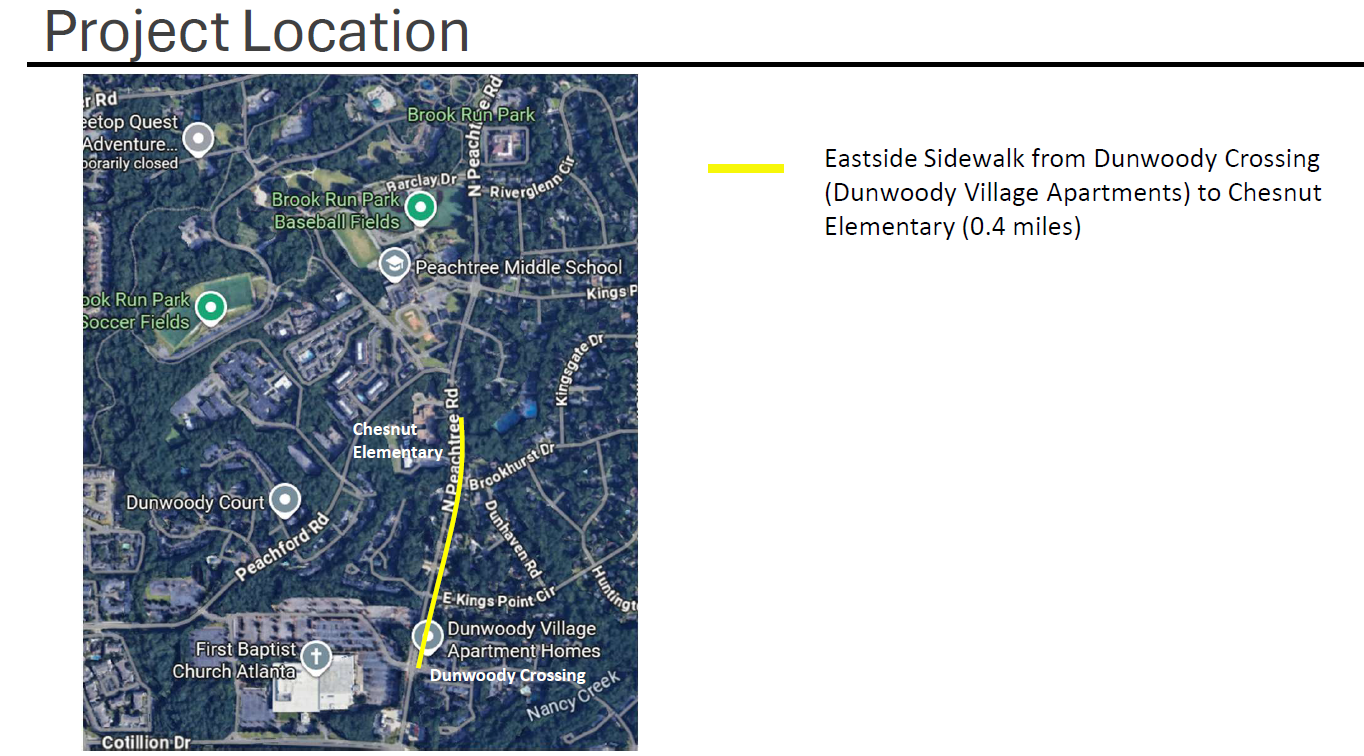
Staff proposal
Why This Corridor Matters
North Peachtree Road serves:
Chesnut Elementary School
Peachtree Middle School
Several neighborhoods where families already walk, bike, and drive daily
At peak arrival and dismissal times, pedestrian and vehicle activity overlap heavily. Providing safe, separated space for walking and biking is not just about convenience—it’s about preventing serious injuries and saving lives.
A Modest Refinement with Meaningful Impact
After reviewing the staff proposal—and after hearing real-time feedback from a Dunwoody North parent whose child attends Chesnut Elementary—I am proposing a small but important refinement:
👉 Extend the sidewalk an additional 0.2 miles (about 1,000 feet) north to Kings Point Drive, directly across from Peachtree Middle School.
This would bring the total project length to approximately 0.6 miles.
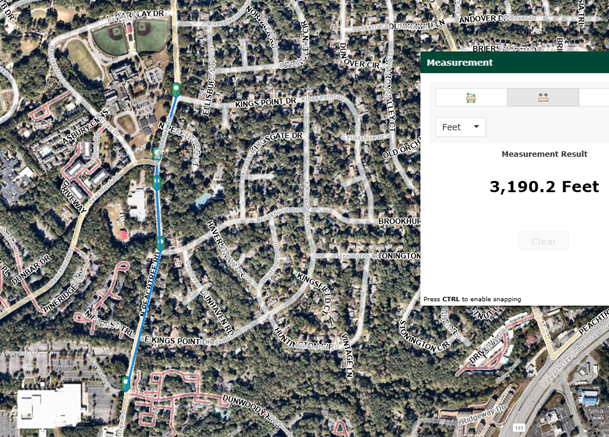
My proposal: 1,000-ft 2/10 mile extension to Kings Point Drive.
Why Extend to Kings Point Drive?
This modest extension would:
Serve two schools instead of one
Providing Safe Routes to School access for both Chesnut Elementary and Peachtree Middle School.End at a signalized intersection
Creating a clear, logical project endpoint that improves pedestrian safety and reduces the likelihood of a future standalone gap project.Expand neighborhood access
Reaching more homes in Dunwoody North and benefiting families who already walk along this corridor.Make better use of work already underway
Extending the benefit of design and right-of-way work that is already being pursued.
How This Would Be Funded
Transparency around funding matters, especially when we’re talking about long-term infrastructure investments.
One of the funding tools identified for this project is LMIG (Local Maintenance & Improvement Grant), a state transportation program administered by the Georgia Department of Transportation. LMIG provides annual funding to cities and counties across Georgia for roadway and pedestrian infrastructure improvements, including sidewalks, safety enhancements, and maintenance projects.
More information on LMIG is available here:
https://www.dot.ga.gov/GDOT/pages/LMIG.aspx
In Dunwoody, our five-year Capital Improvement Program (CIP) is primarily funded through SPLOST (Special Purpose Local Option Sales Tax). SPLOST dollars are used for major capital investments such as roads, parks, facilities, drainage, and other long-lived public infrastructure.
You can see how Dunwoody’s SPLOST funds are allocated here:
https://www.dunwoodyga.gov/government/departments/finance/dunwoody-splost
The City’s adopted 2026 Budget includes the five-year Capital Improvement Program (CIP), which outlines planned capital projects and funding sources on a rolling basis. The CIP—shown beginning on page 46 of the 2026 Approved Budget—reflects that most major capital projects are funded through SPLOST, while other tools such as LMIG are programmed separately as part of the annual budget process.
The full 2026 Approved Budget is available here:
https://www.dunwoodyga.gov/home/showpublisheddocument/4086/638937816333230000
For this project specifically:
The staff recommendation includes $400,000 in ARPA funding.
A specific funding source for the remaining gap has not yet been identified in the staff proposal.
The proposed extension uses the same per-linear-foot cost assumptions reflected in the staff recommendation, applied proportionally to the additional segment.
The remaining funding gap could be addressed by applying LMIG funding in 2027 and 2028.
Because LMIG allocations for those future years have not yet been programmed, applying LMIG funding in 2027 and 2028 for this sidewalk project does not displace any currently programmed CIP projects or require a retroactive budget change, and can be incorporated through the normal annual budget process moving forward.
In short, this proposal uses the right funding tools for the right purposes—SPLOST for major capital investments and LMIG for targeted roadway and pedestrian improvements—while remaining fiscally responsible and consistent with how the City already plans and budgets infrastructure projects.
How This Fits Into Dunwoody’s Adopted Plans
This proposed sidewalk extension aligns directly with transportation and safety plans the City has already adopted:
Sidewalk & Pedestrian Improvement Program
https://www.dunwoodyga.gov/government/departments/public-works/sidewalks-and-pedestrian-safetyRoad Safety Action Plan
https://www.dunwoodyga.gov/government/master-plans/road-safety-action-plan
This project represents a practical, near-term implementation of those adopted plans by improving safety and connectivity along a corridor serving two schools and multiple neighborhoods.
Safe Streets for All: A Long-Term Commitment
This proposal isn’t about one sidewalk—it’s about a principle.
My red line has always been simple: no fatalities and minimal serious injuries on our streets—whether you’re driving, walking, biking, young, old, or living with a disability.
Since 2019, I’ve worked to advance that goal through safer street design, better pedestrian infrastructure, and stronger connections between neighborhoods, schools, and parks. The North Peachtree Road sidewalk project—and this proposed extension—is another step toward creating a city where safe choices are the easy choices.
What Happens Next
City Council will consider this project at its Monday, January 26 meeting. The item is on the published agenda, available here:
https://dunwoodyga.hylandcloud.com/211agendaonline/Meetings/ViewMeeting?id=2908&doctype=1
I plan to offer this refinement as an amendment for Council’s consideration.
Residents who have thoughts or feedback are welcome to share them by emailing the Mayor and City Council and copying the Public Works team ahead of Monday’s discussion.
Mayor & Council: councilmembers@dunwoodyga.gov
Public Works Michael.Smith@dunwoodyga.gov (Director) Michelle.Hirose@dunwoodyga.gov (Deputy Director)
As always, I welcome your thoughts, questions, and am available to meet in-person or for a phone call. (Joe.Seconder@dunwoodyga.gov)
Building safer streets takes thoughtful planning, steady investment, and listening to the people who use them every day.
This proposal reflects all three.
— Joe Seconder
Dunwoody City Council